I build interfaces for a living, and somewhere along the way I noticed that I only really trust a design once I’ve seen it at night. Daylight is forgiving. Dark mode isn’t. Every edge and every bit of contrast has to justify itself, and anything that was only there for decoration disappears.
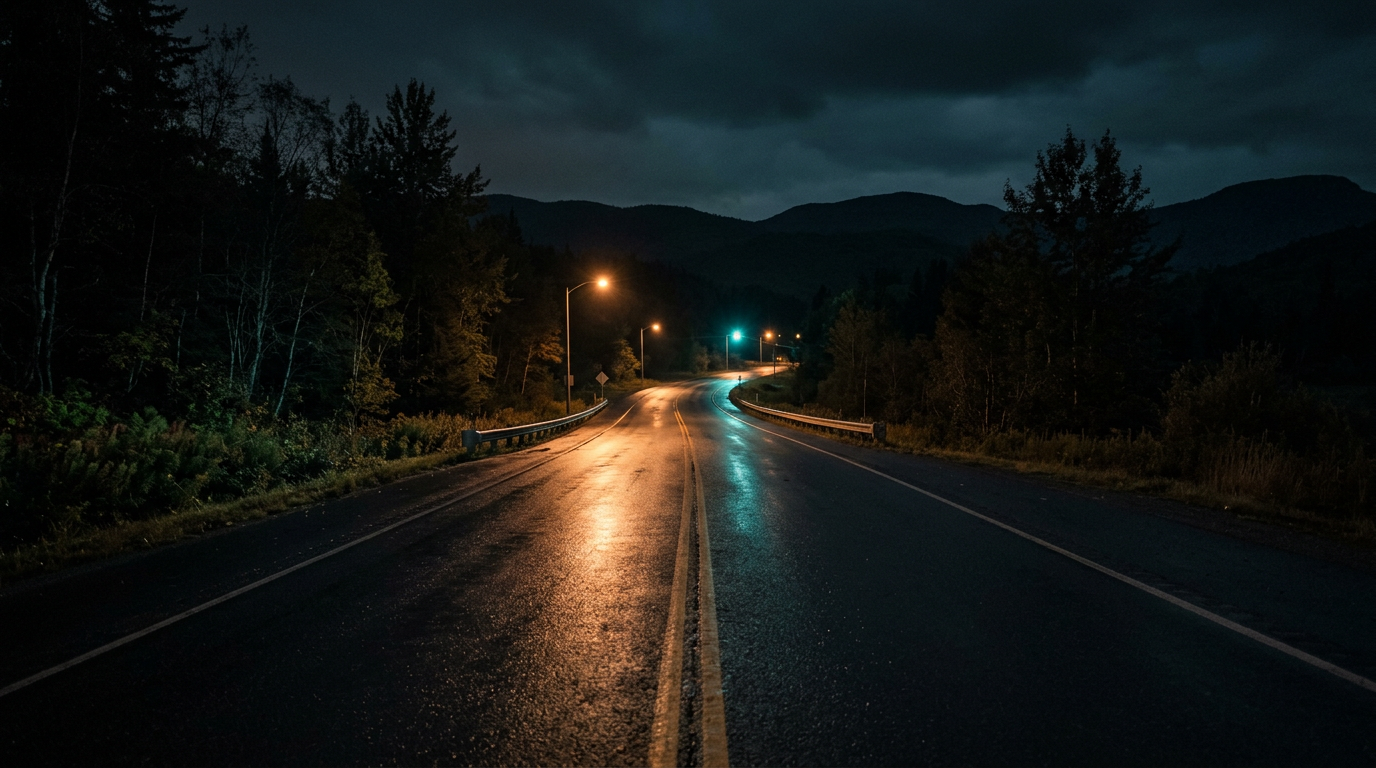
Night driving is the same discipline. The world strips down to headlights, a few lit signs, and whatever you’re listening to. So this is a mix for that hour, in the car or on the iPad with the brightness turned low.
Why dark, why now
The Crystal Design System, to me, is a language of depth rather than darkness. Surfaces hold light instead of swallowing it. Images run edge to edge and the interface steps back so the picture can breathe. Nothing shouts. When it works, the screen feels like a window at night with a few warm lights on the far side of the glass.
That is also what a good night-drive song does. It leaves room and lets the dark be part of the arrangement. I picked these seven because each one anchors to a specific moment, and each earns its place for a different reason.
The mix
- Kavinsky, “Nightcall.” This one is for leaving. It’s the moment you pull out of the driveway, the streetlights start to repeat, and the synths come in like a city you haven’t reached yet. It’s the most neon thing here, and I keep it first on purpose, like the accent color you use once and then trust the dark to do the rest.
- Tycho, “A Walk.” I’d say this is the one for the open stretch, but honestly it’s just as good on foot. It’s warm and patient, with guitars that feel like dawn is a rumor rather than a plan. It anchors to the first long straight road, when the radio static finally clears and you stop checking the time.
- Fleetwood Mac, “Dreams.” This is the human one. It sits at the point in the night when you start thinking about people, and it moves slowly enough to let you. Everything is spare, with a bass line that barely moves and a voice sitting right in front of it. It’s a good reminder that restraint is a feature.
- Massive Attack, “Teardrop.” This is for the tunnel, the underpass, or any stretch where the lights go amber and the world gets narrower. The pulse is steady and a little uneasy. In interface terms, it’s the glow on a dark surface that tells you something is alive in there without needing to announce it.
- Miles Davis, “Générique.” I come back to this trumpet more than almost anything else for night. It comes from the score Miles recorded for a French film in the late fifties, and it still sounds like rain on a windshield and a city that’s closed its shops. It anchors to wet pavement and reflections, and to slowing down on purpose.
- Daft Punk, “Nightvision.” This is the shortest thing here and the softest. It’s a small, glowing instrumental that works like a breath between chapters. I use it when I’ve been driving long enough that the road has become a kind of meditation, and I want the mix to acknowledge that rather than push past it.
- Brian Eno, “An Ending (Ascent).” This one is for arriving, or for pulling over and turning the engine off and sitting there a minute. It doesn’t resolve so much as thin out, like the last light on a horizon. It’s the closest music gets to a full-bleed image: nothing in the frame except the feeling.
What the pairing taught me
I didn’t set out to connect the playlist to design work, but the overlap is hard to ignore. The best night music and the best dark interfaces both do the same thing. They trust negative space. They let one bright element carry the weight, and they never confuse volume with presence.
When I’m building, I keep catching myself adding one more highlight, one more border, one more bit of glow. Then I put on something like “Dreams,” look at the screen again, and take half of it back out. The dark isn’t an empty canvas that needs filling. It’s the material.
How I listen
I’d start it at the first real dark, not at dusk. Let “Nightcall” do its work, and then stop reaching for the skip button. The order matters because the energy only goes one way. It rises early, settles in the middle, and by the Eno it’s mostly air.
If Sophie is in the car, “Dreams” is the one that usually gets a quiet comment or a hand on the volume. If I’m alone, it’s the Miles that gets me. Either way, the road does what it does, the Loom keeps its own slow pattern somewhere behind it all, and the songs hold the dark open a little longer.
That’s the whole mix. Low brightness, a full tank, and nowhere in particular to be until the last track fades out.
Leave a Reply