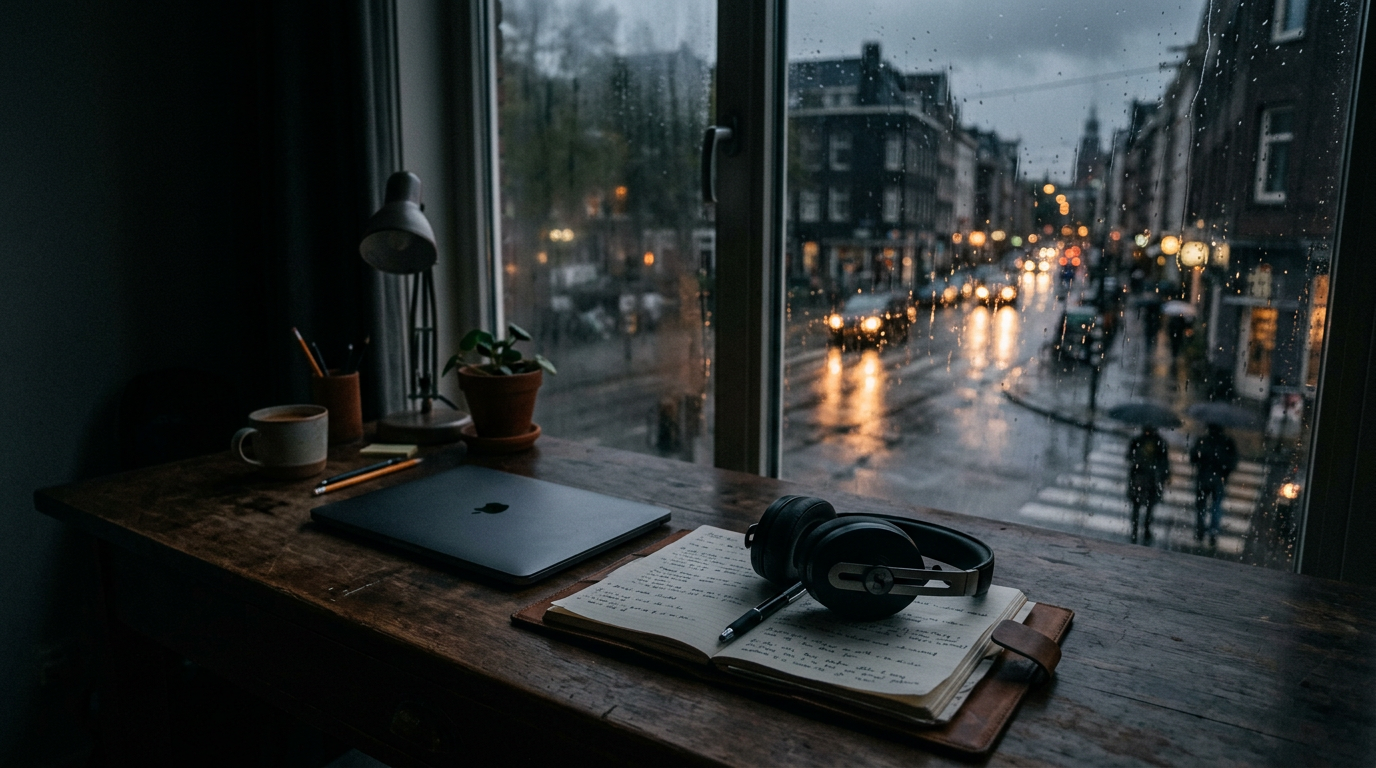
There’s a stretch of old front-end code I’ve been avoiding. Stylesheets that argue with each other, components that grew sideways, a few comments that say only “don’t touch.” Nothing is on fire. It just needs doing, and it needs doing slowly.
That’s the part worth saying out loud. These days an assistant can hand me a full rewrite in minutes, so going slowly is now a choice. Slow is how I find out what the old code was actually trying to do, and what it was protecting. So I built a playlist to keep my pace honest.
Why this mix, why now
Nothing here has a big drop, and nothing wants to be the main character. Everything either repeats, builds, or breathes. That’s what a refactor asks of me: repeat small moves, build gradually, leave room.
The order follows the work, from first look to last commit.
1. Brian Eno, “An Ending (Ascent)”
Anchors to: opening the file and touching nothing.
This is for the first read, when the only job is to look. The track lifts without ever hurrying, which is the posture I want before I’ve earned any opinions. I scroll, I note what’s strange, and I resist the urge to fix the first ugly thing I see.
2. Bill Evans, “Peace Piece”
Anchors to: writing down what the code does today.
A steady left-hand figure sits underneath while the right hand wanders. I think of the left hand as the tests and the notes: the stable thing describing current behavior, flaws included. Everything I improvise afterward is safe to try because that ground stays put.
3. Steve Reich, “Piano Phase”
Anchors to: the first small, boring passes.
Two pianists play the same pattern, and one drifts very slightly ahead until the two lines lock into something new. That’s renaming, moving, and tightening one thing at a time while the old and new shapes briefly coexist. It sounds mechanical, then it starts to sound like a decision being made.
4. Nils Frahm, “Says”
Anchors to: the long middle.
This is where the work stops being clever. It’s extracting, deleting, and re-running the build. “Says” begins with a small pulse and gives you every reason to stay with it, then gathers weight so gradually you can’t point to the moment it changed. That’s the feeling I want from a good middle stretch: no heroics, just accumulation.
5. Ryuichi Sakamoto, “andata”
Anchors to: the snag.
Every refactor has one. A specificity fight, a layout that only works because of three accidents, a component nobody can explain. “andata” is spacious and a little melancholy, and it doesn’t push. When I’m stuck, I don’t want energy. I want permission to stop forcing it.
6. Tycho, “A Walk”
Anchors to: leaving the desk.
The title does the work. When the snag won’t move, I put on my shoes and go. The answer usually shows up somewhere around the second street, unrelated to anything I was looking at. I come back to the Loom with the problem a little smaller than I left it.
7. Max Richter, “On the Nature of Daylight”
Anchors to: deleting dead code.
Removing old code is quietly emotional. Somebody solved a real problem there, maybe me, years ago. The strings here hold grief and gratitude in the same breath, which is how I’d like to treat that deletion. Thank it, then let it go.
8. Miles Davis, “Blue in Green”
Anchors to: the last review before I merge.
It’s unhurried and a little unresolved, and it doesn’t pretend to be finished. Neither is the codebase. I read the diff once more, make sure it’s smaller and kinder than what it replaced, and stop there. Tomorrow has its own pass.
The ground rules I play it under
- One intention per commit, and the playlist can run past it.
- Understand a thing before replacing it, even if a rewrite is one prompt away.
- If I’m stuck for a whole track, I take a walk.
- Leave the code a little clearer than I found it, not perfect.
What it’s really for
Refactoring rarely gets a celebration. Nobody sees the change, and if I’ve done it well, nothing looks different. The reward is quieter: the next person, probably me, opens the file and isn’t afraid of it.
So this is music for work that makes no noise. Start with Eno, end with Miles, and take the walk in the middle.
Leave a Reply